

Imagine a production system where events are being generated every second, but the services responsible for processing those events slowly start falling behind. Messages begin piling up in the queue, dashboards show increasing delays, and downstream systems stop receiving real‑time updates. In many Kafka-based systems, this situation appears as one common operational issue: consumer lag. This is where the right technology partner can quietly make a difference—bringing the expertise needed to turn these possibilities into scalable, real-world solutions, much like the work we do at Payoda.
In this article, we explore what Kafka consumer lag is, why it happens in production environments, and how I investigated and resolved it.
Understanding the Basics of Kafka
Before understanding consumer lag, let’s first understand what Kafka is and why it is widely used as a messaging system in modern distributed applications.
In many systems, multiple services need to exchange information with each other. If every service directly calls another service whenever it needs data, the system can quickly become tightly coupled and difficult to scale. Apache Kafka helps solve this problem by acting as a central messaging platform where services can publish events and other services can consume those events independently.
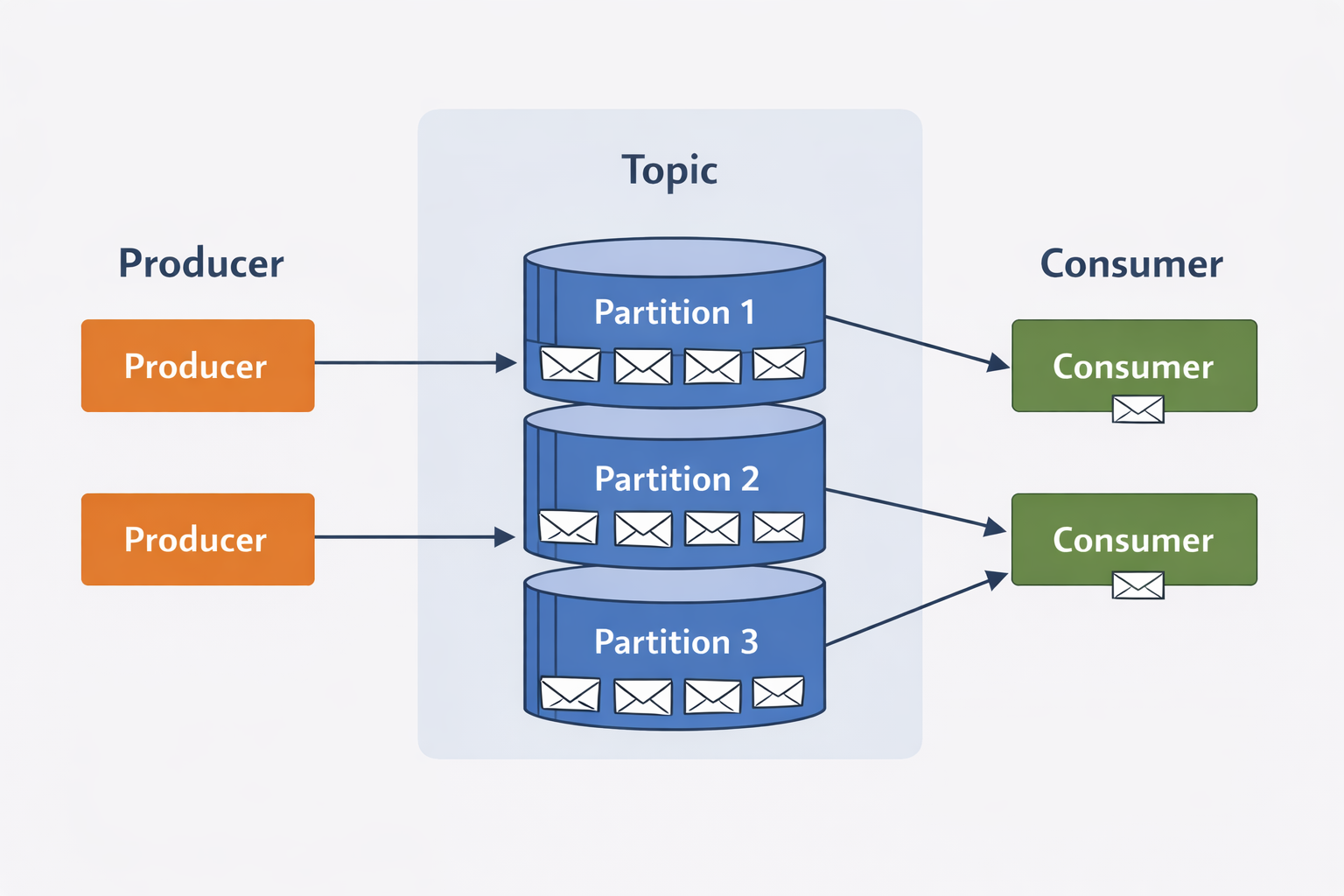
In simple terms, Kafka allows producers to send events (messages) to a central system, while consumers read and process those events asynchronously. This makes communication between services more flexible and reliable, since producers and consumers do not need to directly interact with each other.
A common example is a transaction event. One service may produce an event whenever a transaction occurs, and multiple other services can consume that event to perform tasks such as processing the transaction, updating databases, triggering notifications, or running analytics.
Kafka organizes messages into topics, which can be thought of as logical streams of events. Each topic is further divided into partitions, allowing Kafka to distribute data and processing across multiple consumers. Partitions play a crucial role in Kafka’s scalability, as they allow large volumes of messages to be processed in parallel.
While Kafka is highly scalable and reliable, one operational issue that frequently appears in production environments is consumer lag. Consumer lag occurs when consumers are unable to process messages as quickly as they are produced. As lag grows, messages accumulate in Kafka topics and downstream systems begin to experience delays in processing events.
What is Kafka Consumer Lag?
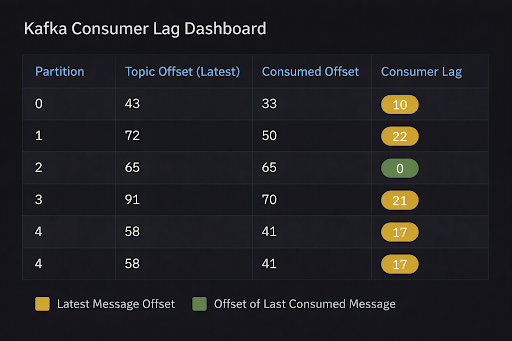
Consumer lag refers to the difference between the latest message offset available in a partition and the offset that the consumer has processed so far. In other words, it indicates how far behind the consumer is compared to the newest messages being produced.
When the gap between these two offsets grows continuously, it indicates that consumers are unable to keep up with the incoming stream of messages.
Common Causes of Consumer Lag
A growing consumer lag usually indicates that consumers are unable to keep up with the rate at which messages are being produced. This situation can arise due to several reasons related to message production rate, processing errors, or system capacity.
Some common causes include:
- Producers sending messages faster than consumers can process them.
If the rate at which producers publish messages is higher than the consumer processing rate, messages start accumulating in Kafka partitions. - Consumers encountering errors or retries.
If message processing fails, retry mechanisms may repeatedly attempt to process the same message. This increases processing time and reduces throughput. - Insufficient processing parallelism.
The level of parallel processing depends on the number of topic partitions and the number of consumer instances or stream threads available.
Understanding Parallelism with an Example
Example configuration:
Topic partitions = 4
Pods = 2
threads = 2
Each pod runs two stream threads, giving a total of:
2 pods × 2 threads = 4 processing threads.
Pod | Thread | Partition |
Pod 1 | Thread 1 | Partition 0 |
Pod 1 | Thread 2 | Partition 1 |
Pod 2 | Thread 1 | Partition 2 |
Pod 2 | Thread 2 | Partition 3 |
The Solution
To restore system throughput and eliminate the backlog, several improvements were introduced.
- Increasing the number of consumer pods. More consumer instances increased the number of stream threads available for processing.
- Increasing Kafka topic partitions. Since parallelism is limited by partition count, increasing partitions allowed more consumers to process messages simultaneously.
- Resolving processing errors. By identifying repeated processing failures in logs and fixing the service logic, retries were reduced and overall throughput improved.
Key Takeaways
- Consumer lag represents the gap between the latest produced message and the last processed message.
• Lag often occurs when message production rate exceeds consumer processing capacity.
• Kafka parallelism is limited by the number of partitions in a topic.
• Scaling consumer pods, increasing partitions, and resolving processing errors can significantly reduce lag.
• Monitoring logs, metrics, and consumer offsets is critical for maintaining healthy Kafka consumers.
Final Thoughts
Kafka offers strong scalability and reliability for event-driven systems, but challenges like consumer lag demand continuous monitoring and optimization. By understanding processing patterns, maintaining system visibility, and scaling consumers effectively, teams can ensure stable and efficient pipelines.
However, managing these systems at scale requires the right mix of architecture, observability, and operational expertise. This is where experienced partners like Payoda can help, bringing the capability to design and optimize resilient streaming solutions. As event-driven systems grow in complexity, getting the fundamentals right becomes critical.
Connect with Payoda to build and scale reliable, high-performance event streaming systems that deliver real impact.
Talk to our solutions expert today.
Our digital world changes every day, every minute, and every second - stay updated.