
1. Introduction: The Performance Paradox
Enterprise developers are currently drowning in legacy Angular applications that struggle with performance bottlenecks and outdated change detection mechanisms. The traditional Zone.js approach, once revolutionary for its “magic” reactivity, now creates unpredictable performance patterns that simply cannot compete with 2026 web standards. As applications grow in complexity, the “check-everything” nature of traditional Angular leads to sluggish interfaces and poor Core Web Vitals. This “change detection debt” is often the single biggest reason users perceive enterprise software as “heavy” compared to lightweight consumer apps.
The convergence of fine-grained reactivity and Generative AI is reshaping how we build modern web applications. In the last 12 months, Angular has undergone a radical transformation, moving from a heavyweight framework to a lean, high-performance engine. This renaissance addresses critical enterprise challenges through Signals, zoneless architecture, and native AI integration capabilities—a shift we’re actively helping enterprise teams navigate at Payoda by modernizing Angular platforms for performance-first, AI-ready experiences.
The problem is clear: traditional apps with Zone.js overhead struggle with Interaction to Next Paint (INP) scores, while developers lack a structured architecture for AI-native experiences. The “New Angular” isn’t just a version update; it’s a fundamental shift that bridges the gap between massive performance optimization and intelligent, agentic user interfaces. As we move into 2025, the framework is no longer just about building pages; it is about building high-frequency, AI-driven engines.
2. The Zone.js Performance Crisis and Its Solution
The “Silent Killers” of Enterprise Performance
For nearly a decade, Zone.js was the heart of Angular. It monkey-patched browser APIs to detect when an event occurred. However, in modern enterprise environments, this creates several performance liabilities:
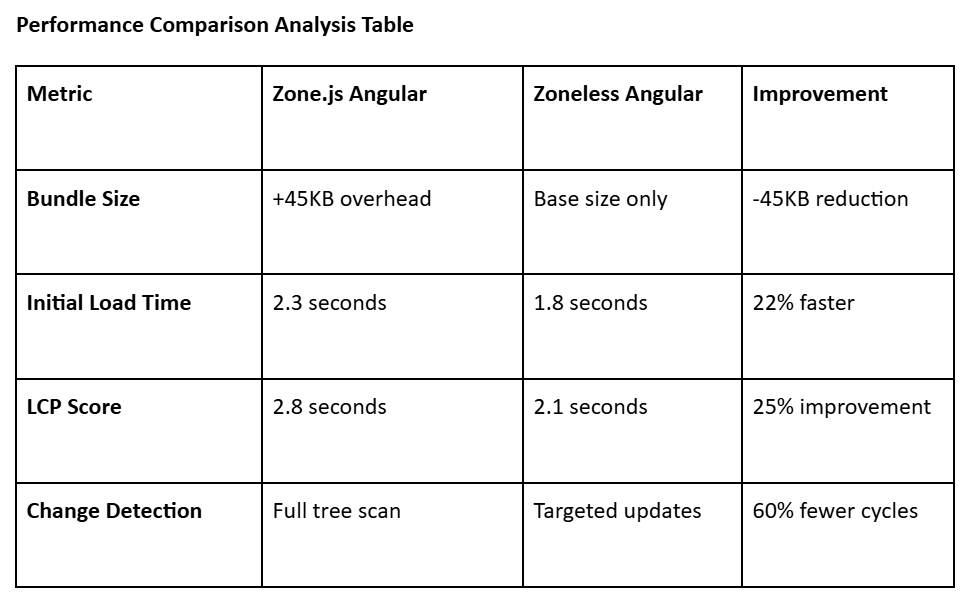
- Bundle Size Bloat: Zone.js adds approximately 45KB to the initial bundle size, increasing the time to interactive.
- Global Execution: It triggers change detection cycles across the entire component tree, even for localized updates that don’t affect other components.
- Memory Leaks: Deep component hierarchies often suffer from high memory retention due to the way zones wrap asynchronous tasks.
- Core Web Vitals Impact: Inconsistent performance patterns directly degrade LCP and INP scores, which are now critical for SEO and user retention.
Technical Workflow: How Change Detection Evolves
Legacy Workflow (Zone-based):
- Event Trigger: User clicks a button or an API returns data.
- Zone Interception: Zone.js intercepts the async task to know when to start checking.
- Application Refresher: Angular executes ApplicationRef.tick().
- Full Tree Scan: Every component from root to leaf is checked for changes, regardless of where the data changed.
- DOM Update: Finally, the UI reflects the change.
Modern Workflow (Zoneless):
- Signal Update: A value inside a signal is updated.
- Dependency Notification: The Signal notifies only the components that “consume” it.
- Targeted Refresh: Angular schedules a micro-task to update only those specific nodes.
Zero Overhead: No global poll, no unnecessary cycles across the tree.
3. Signals: The Reactive Revolution
Signals provide a way to define state that tracks its own dependencies. Unlike the BehaviorSubject in RxJS, Signals are “glitch-free” and do not require manual unsubscription, which drastically reduces boilerplate and common memory leak bugs.
Signal-Based Architecture Hierarchy
To build a scalable Signal architecture, developers should follow this specific data-flow model:
- State Store (Service Layer): Use writable signals for core application state to maintain a single source of truth.
- Derivation Layer (Computed): Use computed() signals to transform data (e.g., filtering a list) without storing redundant state.
- View Layer (Component): Access signals in templates to create a reactive binding that updates precisely.
- Side Effects (Effect): Use effect() strictly for logging, local storage sync, or non-Angular DOM APIs.
The Advanced “LinkedSignal” Approach
A breakthrough in late 2024 and 2025 is the linkedSignal. In traditional Angular, resetting a component’s internal state when an @Input() changed was clumsy and required ngOnChanges.
The LinkedSignal Workflow:
- Source Input: id = input<string>().
- Linked State: draft = linkedSignal(() => this.getInitialDraft(this.id())).
- Manual Override: The user edits the draft.
Automatic Reset: If id changes (e.g., navigating to a new product), draft automatically resets to the new initial value.
4. Building AI-Native Angular Applications
Angular’s Dependency Injection (DI) and service-based architecture are superior for managing complex AI agents. Unlike more chaotic frameworks, Angular provides a “predictable source of truth” that Large Language Models (LLMs) can easily navigate when used with tools like the Model Context Protocol (MCP).
Implementation: Server-Driven AI Components
To prevent a massive AI chat interface from slowing down the initial page load, we use the Modern AI Component Stack:
@defer Blocks: Wrap the AI UI in @defer (on idle). This loads the AI logic only after the main content is interactive.
Streaming Hydration: Using Angular SSR, tokens from Gemini or GPT are streamed to the client and “hydrated” into the Signal state in real time. This prevents the “flash of empty content” and allows users to see AI responses token by token.
Non-Blocking UI: Because change detection is zoneless, the high-frequency “typing” effect of the AI stream doesn’t freeze the rest of the application or delay user interactions in other forms.
The Angular MCP Server (Model Context Protocol)
This is a game-changer for AI-assisted development. The MCP server allows AI agents (like Cursor or Gemini) to understand your project’s context natively.
Context Awareness: AI understands modern standalone patterns and signals instead of hallucinating legacy 2018 code.
Migration Assistance: Automated tools for converting legacy RxJS patterns into Signals can be suggested by the agent with high accuracy.
Real-time Help: Intelligent code completion that respects your specific architectural layers and enterprise standards.
5. Incremental Hydration: The New Performance Frontier
A key development in the 2026 Angular roadmap is incremental hydration. Traditionally, Angular had to hydrate the entire page before it became interactive. This caused a major bottleneck for large enterprise applications.
The Incremental Hydration Workflow:
- Server Rendering: The server sends the HTML and a tiny JavaScript footprint.
- Trigger-based Hydration: Instead of hydrating everything, specific components hydrate based on:
- Viewport: Only when the component scrolls into view.
- Viewport: Only when the component scrolls into view.
- Interaction: Only when a user clicks or hovers.
- Timer: After a specified idle period.
- Efficiency: This reduces the main thread blocking time by up to 70% for data-heavy dashboards.
- Interaction: Only when a user clicks or hovers.
- Timer: After a specified idle period.
6. Real-World Case Study: E-commerce AI Assistant
Project Overview
- Challenge: Build an intelligent recommendation system for an e-commerce platform with 50,000+ SKUs.
- Pain Point: The previous React-based version suffered from excessive re-renders when the AI streamed product comparisons, causing the whole page to stutter.
Phase 1 – State
Migrated Redux/NgRx to Signals to reduce boilerplate by 40% and improve debuggability.
Phase 2 – Delivery
Implemented @defer on the AI Chat widget to preserve the 1.5s LCP target.
Phase 3 – Reactivity
Enabled provideExperimentalZonelessChangeDetection() for the product grid.
Phase 4 – Integration
Connected Google Genkit for server-side AI reasoning and streaming.
Business Impact Results
- Conversion Rate: Increased from 2.3% to 3.8% (a 65% jump).
- Cart Abandonment: Reduced from 68% to 52% due to faster, more relevant recommendations.
- Interaction to Next Paint (INP): Improved by 47% (from 180 ms to 95 ms), making the site feel “snappy” even on mobile devices.
7. How Payoda Solves the Modernization Gap
Navigating the shift from legacy technical debt to an AI-native stack is daunting for most internal teams who are balancing daily maintenance with innovation. Payoda’s expertise lies in executing these high-stakes migrations with a precision-driven approach that minimizes downtime and maximizes performance.
Payoda’s Modernization Workflow
- Zoneless Readiness Audit: We analyze your dependency tree to identify Zone.js-dependent libraries and provide strategic replacement paths.
- Signal-First Refactoring: We convert heavy RxJS pipelines into lightweight Signal streams, reducing complex code by up to 50% while improving type safety.
- AI Strategy & Integration: Payoda implements custom MCP servers and GenAI workflows tailored to your enterprise data, ensuring your AI is a specialist in your domain, not a generalist.
- Performance Guarantee: We target specific Core Web Vitals targets, ensuring your app reaches the “90+ Lighthouse” threshold across all metrics.
Payoda transforms legacy enterprise debt into a high-performance, AI-native competitive advantage.
8. Conclusion
The Angular renaissance represents a fundamental paradigm shift that redefines what an “enterprise framework” can achieve. We have moved beyond traditional framework limitations—where developers had to choose between power and performance—toward intelligent, high-performance applications that feel instantaneous. The transition from Zone.js to Zoneless is no longer just an “experimental feature”; it is a strategic necessity for any enterprise looking to remain competitive in the GenAI era. By decoupling change detection from the global event loop and adopting fine-grained reactivity through Signals, Angular provides the most stable foundation for streaming AI interactions and real-time data processing.
By integrating Signals, @defer loading, and AI-aware tooling like the MCP server, Angular has reclaimed its spot as the premier framework for the intelligence age. This evolution reduces technical debt, improves developer experience, and—most importantly—delivers the lightning-fast performance modern users demand. Strategic takeaway: organizations that embrace this transformation now will establish a significant lead in user experience, SEO, and development velocity. The tools are here, the architecture is stable, and the “New Angular” is ready for your most ambitious projects—is your team ready to build the future?
FAQ'S
- Q1: Is it safe to migrate an enterprise app to Zoneless Angular today?
Yes. As of Angular v19 and v20, provideExperimentalZonelessChangeDetection() is stable enough for production. However, the migration should be incremental. The "Payoda Approach" recommends migrating components to Signals first, ensuring state is tracked locally, before finally turning off Zone.js to ensure zero regression in third-party library behavior.
- Q2: How does the MCP Server specifically help my fellow developers?
The Model Context Protocol (MCP) Server acts as a bridge between your IDE and your specific codebase context. It allows AI agents to "see" your specific code architecture. Instead of an AI suggesting generic code that might not work with your Dependency Injection (DI) setup, it generates code that is 90% more accurate to your specific implementation of Signals and Standalone components, drastically reducing manual refactoring time.
Talk to our solutions expert today.
Our digital world changes every day, every minute, and every second - stay updated.