
Introduction:
Artificial Intelligence is no longer an idea confined to futuristic films or advanced research centers. It has slowly blended into the routine activities of everyday life. From voice assistants like Siri and Alexa to the personalized suggestions we see on platforms like Netflix, AI silently supports many of the choices we make throughout the day. Even the development of self-driving cars shows just how deeply this technology is becoming intertwined into our surroundings. As AI goes on to advance, it is introducing fresh possibilities for countless industries while reshaping how the workplaces function. Long-established ways of working are being redefined, and organizations have started to look for new types of skills in their employees. Technology teams at companies like Payoda are already navigating this shift by helping businesses adapt AI thoughtfully into their operations, ensuring it complements human expertise rather than replacing it.
The change speaks volumes of a workplace that moves faster than ever, and people need to stay tuned to how these shifts may influence their careers. Policymakers also have an important role in understanding the effect of AI on employment trends, job responsibilities, and overall labor patterns. On the other hand, identification of such changes allows society to prepare for a future in which people and intelligent systems work productively together.
The Promise of AI: Productivity, Efficiency, and Innovation
AI offers huge potential to build any workplace across industries. Key areas include:
- Automating repetitive work: AI can be put to automating repetitive rule-based work so that humans can engage in more strategic activities.
- Predictive analytics: AI looks for patterns in data so as to forecast trends and minimize errors, as well as to optimize decision-making.
- Intelligent Decision-Making Systems: AI complements human decision-making by presenting actionable insights from data that are difficult or impossible to digest.
The real-world application:
- Customer Service: AI chatbots jump to thousands of inquiries at once and thereby reduce the response time to complicated matters addressed by human operators.
- Manufacturing: AI-driven predictive maintenance determines when equipment is about to malfunction, thus reducing downtime and saving costs.
- Health: AI-enabled systems can scan records and patient medical scans for early diagnosis at the most critical periods when time could prove to be life-saving.
At Heart: Anxiety Exists Over Jobs and Job Loss
In spite of its benefits, AI has generated some job losses, fears, and anxieties among workers.
- The ones most at risk are manual or routine occupations. Some examples include data entry, basic customer interaction, bookkeeping, and logistics.
AI, however, does not mean humans will be fully replaced. What would, instead, happen is many jobs would transform and require different skills and adaptability.
- According to one estimate by the World Economic Forum, technology could displace 85 million jobs by 2025.
- However, in fields like digital marketing, machine learning, and data analysis, the addition of about 97 million jobs could take place.
The takeaway is that jobs will shift and focus on adaptation and reskilling rather than disappear.
Impact on Jobs and Skills
But the rise of AI is doing more than changing job titles; it is restructuring the very core of how work unfolds. As intelligent systems take over routine and repetitive tasks, the value of human contribution shifts toward areas requiring creativity, judgment, and emotional understanding. This move has placed reskilling at the heart of workforce development. Workers can no longer depend on experience or traditional roles; rather, they must learn new tools, technologies, and approaches to remain relevant in an AI-supported environment.
Reskilling is no longer an option; it’s a demand.
It is no longer possible for employees to rely on static job descriptions or traditional career paths. This means that as AI takes over operational tasks, workers must shift to roles that require analysis, collaboration, and decision-making. Such a shift is creating a strong need within companies for continuous learning programs and higher expectations for individuals to actively invest in their own development.
Skills Rising in Importance
Multiple capabilities will become core for any industry to remain future-ready:
- Critical thinking and problem-solving: Interpreting insights generated by AI and making appropriate decisions.
- Data literacy: To understand, validate, and apply data efficiently in daily working routines.
- Digital communication would involve working with artificial intelligence tools, digital platforms, and virtual collaboration systems.
- Adaptability and creativity: Quickly changing with the evolving jobs and finding solutions other than what automation can output.
Industry-Specific Shifts
AI adoption makes the difference in different industries:
- Health: AI supports diagnosis, but human judgment and empathy are at its core.
- Finance: Today, analysts oversee the AI-driven fraud detection and risk-scoring systems.
- Retail: Interactions with customers combine automated service with human-led relationship building.
- Manufacturing: Predictive maintenance and robotics require technicians with a hybrid of digital-mechanical skills.
It’s just that AI is not taking jobs away, but it’s actually redefining what meaningful work is and pointing to the skills that help people grow along with intelligent systems.
Human and Machine: Towards a Collaborative Future
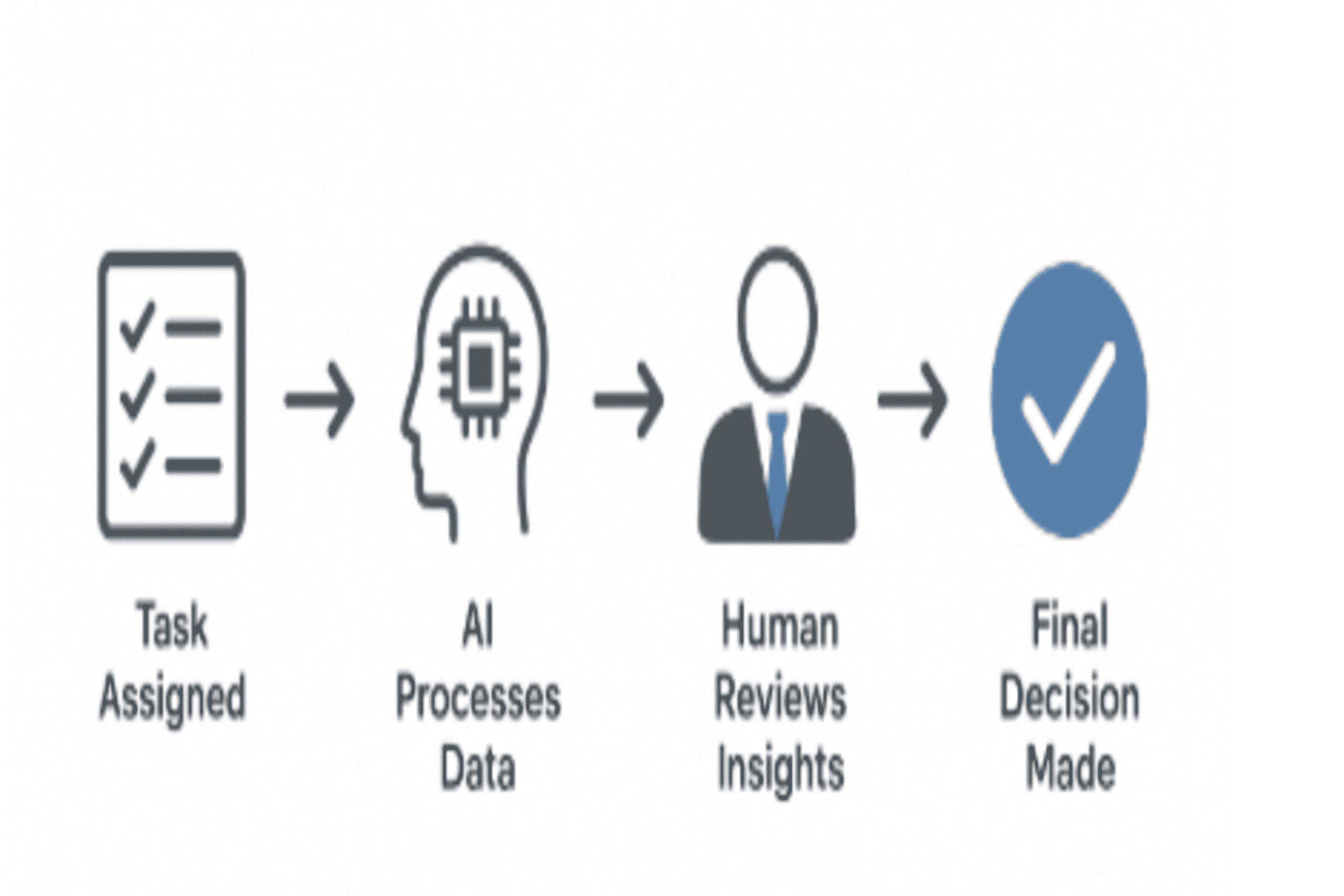
AI works at its best when joined with human intelligence. Here is the human-in-the-loop take on AI working together:
Human-AI Synergy (Work-)Flowchart:
Real-life examples:
- Healthcare: AI scans hundreds of radiology images, proposing possible findings. Doctors make a final diagnosis and decide on treatment based on data reliability and human judgment and compassion.
- Legal Domain: At the attorney’s behest, AI views thousands of documents for the discovery through a legal and ethical lens and delivers insights that are reviewed by the attorney for a final decision.
- Finance: AI flags suspicious transactions; humans verify and pursue the high-risk ones.
This is why one should understand that AI complements human abilities instead of replacing them. Together, they ensure efficiency without compromising the human factor.
The Skills Revolution: Lifelong Learning as the New Normal
With regard to AI, job specifications are being altered from one end of the sector to the other. Working personnel must be trained in technical and soft skills:
Technical skills:
- Data literacy
- Machine Learning basics
- Digital Communication
Soft skills:
- Adaptability
- Critical Thinking
- Creativity
- Emotional Intelligence
Culture shift:
- One-off learning is not good enough anymore.
- Lifelong learning, reskilling, and upskilling to stay relevant are the “need of the hour.”
Enterprises and governments hold the responsibility for:
- Training multipurpose programs: Industry shall fund staff development.
- Education reform: Engage schools and universities in embedding AI literacy curricula.
- Learning platform accessibility: Government and private institutions must make online courses for upskilling accessible to the masses.
Creating an Inclusive AI-Driven Workforce
AI deployments pose equity and inclusion challenges.
AI, left unregulated, would exacerbate inequality:
- Aid those with access to technology and learning
- Disadvantage those without digital skills
Inclusive growth strategies:
- Reducing digital divide through infrastructure and education
- Upskilling workers who have lost jobs through training programs
- Ensuring AI systems are ethical, unbiased, and transparent
- Multidimensional representation in AI engineering to build solutions beneficial to every population
An example of AI-induced inequality would be an AI finance product developed solely through high-income urban input that might fail to understand the challenges of users in rural areas, thereby accentuating inequality.
Preparation for Everything Starts Now
An AI-powered workforce is not a future fantasy; it is now.
AI is changing:
- How we work (automation, analytics, virtual teamwork)
- What we work on (more creative, strategic, or AI-supported work)
- Who works (new jobs are opening up for tech-literate workers)
What organizations really need to do:
- Collaboration: We need business, educators, and policymakers to collaborate in developing the skills of the workforce.
- Embracing change: Accept that jobs are going to change rather than disappear.
- Inclusivity first: AI must benefit all employees equally.
- Invest in education: Make lifelong learning an institutional practice everywhere.
From here, we can model a future in which both humans and AI complement and collaborate to the fullest extent.
Conclusion
AI does not replace people but supports, extends, and strengthens what they do. The true purpose of artificial intelligence is to supplement, not eliminate, human involvement. In other words, AI should be used as a partner on which one could rely. It should help people to work smarter and take decisions more confidently. Applied responsibly, AI can lighten repetitive tasks, make space for creativity, and free teams to work on decisions that require judgment, empathy, and experience.
That means organizations should position AI as the technology to assist people, not work above them. Only then will workplaces that foster continuous learning and collaboration see the most effect. Correspondingly, individuals need to be curious, learn new skills, and make technology an enhancer of their value, not a threat. This is where Payoda supports organizations in moving forward with confidence. By helping teams adopt AI in a responsible, people-first way, Payoda enables businesses to integrate intelligent systems that strengthen decision-making, collaboration, and long-term growth.
In other words, a future with AI at the helm is more effective and inclusive only if humans remain right at the core of each and every decision. Combining human insight with the speed and accuracy of intelligent systems opens ways for making the work environment one in which innovation grows naturally and human potential expands rather than shrinks. In this vision, AI becomes a catalyst for progress, not a replacement for people.
FAQs
- Will AI replace human workers entirely?
AI will change the way jobs and functions occur, but human beings will need to be there to bring in creativity, empathy, and judgment.
- What can employees do to prepare for the AI-led workforce?
Prioritize lifelong learning, upskilling, digital literacy, and soft skills development, such as adaptability, critical thinking, and emotional intelligence.
- Which industries are expected to see the most growth because of AI?
Industries such as healthcare, finance, manufacturing, and retail are expected to grow significantly due to AI adoption. These sectors benefit from automation, predictive analytics, and intelligent decision-making tools, which create new roles in data analysis, AI oversight, digital operations, and advanced technical support.
Talk to our solutions expert today.
Our digital world changes every day, every minute, and every second - stay updated.