
An unsolved AI problem, hiding in plain sight
By 2026, almost every enterprise has accepted that AI can read documents. Contracts, specifications, regulatory filings, reports. The category is real and the tools work well enough to put into production.
Engineering drawings sit just outside that circle.
You can hand the same model a P&ID and a contract of similar length and get wildly different results. The contract comes back with a clean summary. The drawing comes back with a list of disconnected text fragments and not much else. The model never really read it.
The reason is not compute, model size, or training data. The reason is that a drawing is not a paragraph. Meaning in an engineering drawing is not where it looks like it is.
Where the meaning actually lives
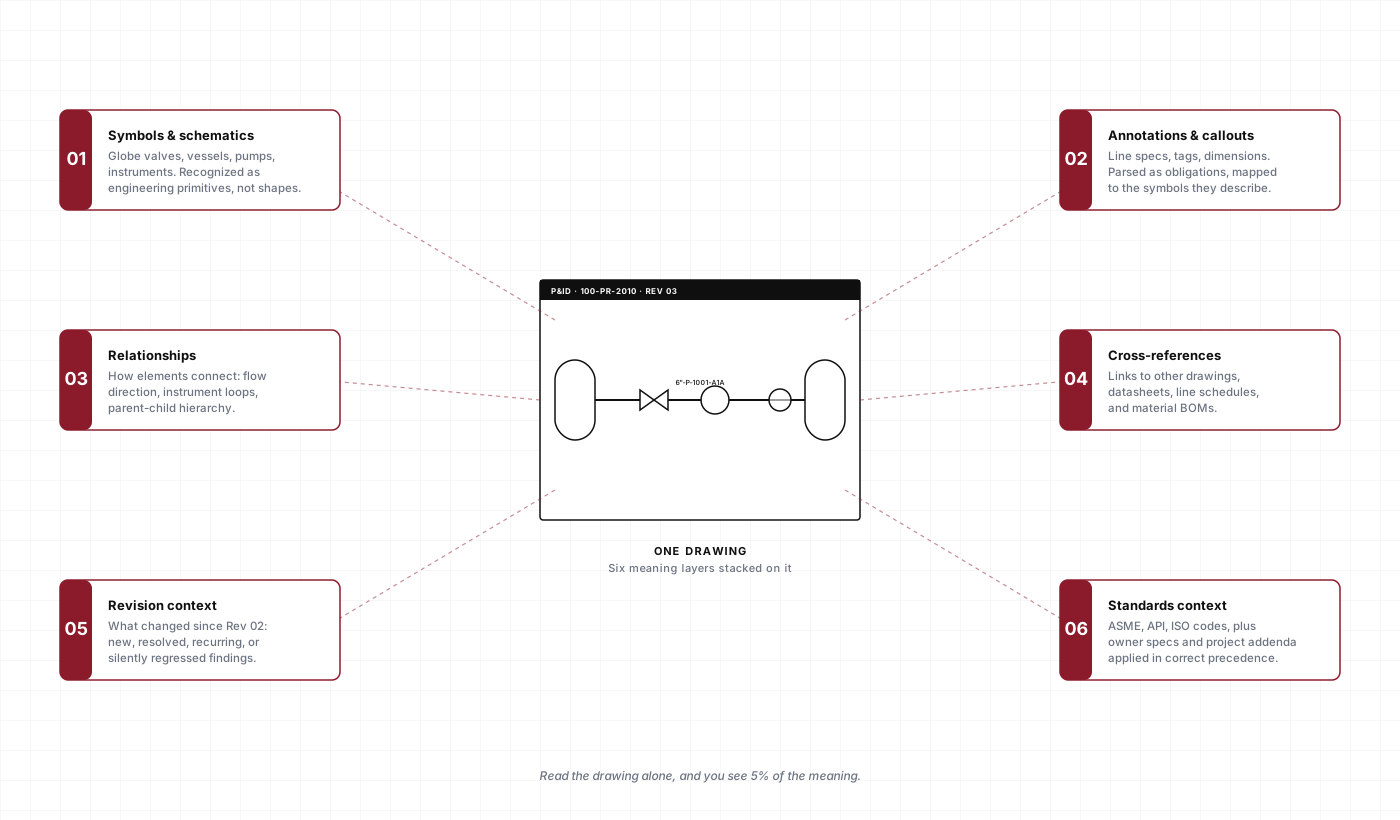
Open a single P&ID and you are looking at six different kinds of meaning sitting on the same sheet. Each one carries compliance weight. Each one has to be understood before the drawing can be read.
Symbols and schematics
What is actually drawn. A globe valve is not two triangles and a circle. It is a globe valve. A reciprocating pump is not a circle with arrows. AI drawing interpretation has to recognize these as engineering primitives, not graphical shapes.
Annotations and callouts
What is written about what is drawn. Line specs, instrument tags, dimensions, material codes, service descriptions. The text on a drawing only means anything when it is mapped to the symbol it describes. AI semantic understanding of drawings starts at this mapping.
Relationships
How elements connect. Flow direction. Instrument loops. Parent-child hierarchies between equipment, lines, and instruments. A valve on a line is a different compliance object than the same valve disconnected. The relationship is the meaning.
Cross-references
Links to other drawings, line schedules, equipment datasheets, and material BOMs. A single P&ID never stands alone. Its meaning is partially defined by what it references. Generic document AI has no way to resolve these references.
Revision context
What changed since the last revision. What was resolved. What was previously flagged but is back. Reviewers do not read every revision from scratch, and neither should AI. Revision context is meaning encoded in time, not in pixels.
Standards context
Which codes apply, in what precedence, and where the owner specifications override the base code. A finding raised against ASME B16.34 alone is incomplete if a project addendum modifies the obligation. AI standards reasoning has to resolve the full stack before a verdict is defensible.
Read the drawing alone, and you see roughly 5% of the meaning. The other 95% lives in these six layers, distributed across systems that a generic AI stack does not even know to look at.
Why OCR and generic AI fail
The most common attempt at AI engineering drawings work runs a drawing through OCR, pipes the extracted text into a large language model, and asks the model to find compliance issues. It does not work, and the reasons are concrete.
- ✕Reads characters, not engineering symbols
- ✕Has no spatial understanding of how elements relate
- ✕Treats line specs and instrument tags as floating text
- ✕Cannot reason about negation, thresholds, or paraphrase
- ✕Has no model of which standards apply, or in what precedence
- ✕Cannot tell what changed between revisions
- ✓Recognizes engineering primitives as primitives
- ✓Reconstructs flow and instrument loop relationships
- ✓Maps every annotation to the symbol it describes
- ✓Parses clauses as obligations with conditions and exceptions
- ✓Applies international, owner, and project standards in precedence
- ✓Classifies findings as new, recurring, resolved, or regressed
Each failure mode on the left is not a bug. It is a category mismatch. The tools were built for documents, and a drawing is not a document. AI blueprint analysis as a category sits between computer vision, document understanding, and engineering knowledge. None of the three on its own is enough.
A drawing is not a document. The tools that read documents were never going to read it.
What standards-aware reasoning actually means
The harder half of AI engineering drawings work is not reading the drawing. It is reasoning about the standards.
A clause is not a rule. It is an obligation with conditions, exceptions, and overrides. "The material shall conform to ASTM A106 Grade B for service temperatures above 200°F" is a single clause, and it carries four pieces of compliance logic at once: an obligation, a condition, a threshold, and a reference to another standard.
Keyword matching cannot evaluate that clause against a deliverable. Similarity matching cannot either. AI standards reasoning parses the clause structure, extracts the obligation, and evaluates the drawing against it under the right conditions.
Then there is precedence. International codes are the base layer. Owner specifications sit on top and override portions of the base. Project addenda sit on top of the owner specs and override portions of those. A defensible AI clause mapping has to resolve the entire stack before raising any finding, because the finding has to cite the actual rule that was violated, not a parent rule that was overridden three layers up.
This is the part of the problem that earlier-generation tools handwaved past. It is the part a senior reviewer has been doing in their head for twenty years.
How drawing intelligence works, end to end
The pipeline below is the architecture, not the implementation. Names of components are intentionally omitted. What matters is the shape of the work.
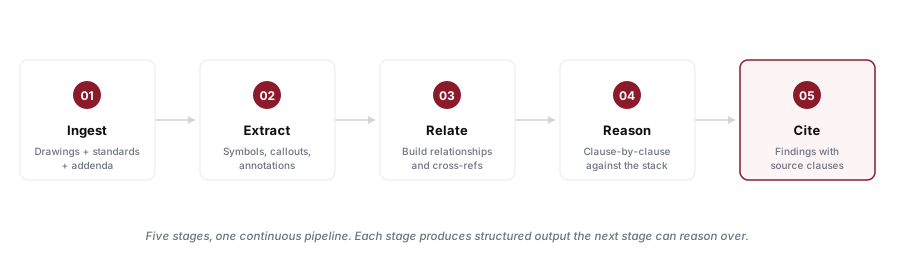
Ingest
Brings in the drawing, the applicable standards, owner specifications, and any project addenda. Standards are indexed at the clause level. Precedence is preserved.
Extract
Runs multi-modal extraction over the drawing itself. Symbols are identified as engineering primitives. Annotations, line specs, and callouts are pulled out and tagged. Vector PDFs preserve more structure than rasterized scans, but both work.
Relate
Reconstructs the engineering meaning. Annotations are mapped to the symbols they describe. Flow direction is inferred. Instrument loops are assembled. Cross-references to other drawings or schedules are resolved where possible.
Reason
Where standards-aware reasoning runs. Every relevant clause is evaluated against the relevant content. Owner-spec and addendum overrides are applied in precedence. Findings are classified by severity and scored for confidence.
Cite
Ties every finding back to the specific source clause and source quote. This is the step that makes the output defensible to an auditor or PMC reviewer. Without it, the rest of the pipeline is unauditable.
From pixel to verdict: one finding, traced
The pipeline is easier to internalize when you watch it produce a single finding. Below is what an AI technical drawing review actually does for one flagged element on one P&ID.
100-PR-2010-Rev03. Recognized as engineering primitive, not graphical shape.6"-P-1001-A1A. Cross-referenced to line schedule: service is hydrocarbon, design pressure Class 600, sour service per project metadata.ASME B16.34 (base code, valve pressure-temperature ratings), owner piping spec §4.2.1 (override for sour service), NACE MR0175 (material requirements).Five stages, one finding. The verdict on its own is just text. The trace is what makes it defensible. A PMC reviewer can follow the same reasoning a senior engineer would, and a senior engineer can scan the trace in seconds to decide whether to approve, override, or escalate.
What this means for engineering judgment
A common worry when AI enters engineering review is that it will replace the senior engineer. The framing is wrong.
A senior reviewer's actual value has never been clause lookup. It has been judgment under ambiguity. Catching the case where the standards conflict. Knowing when a deviation is acceptable. Reading the situation that does not match anything in the standards stack. None of that is automated by AI engineering drawings work, and none of it should be.
What AI removes is the work that should never have been the reviewer's to begin with. Cross-referencing thirty clauses against one valve. Holding the owner spec hierarchy in working memory across a 250,000-document project. Re-reading a revision end to end to find what changed.
The reviewer becomes the decision-maker on the findings that matter, with the trace attached so they can decide quickly. An AI engineering review platform earns its place by surfacing the right findings, with the right reasoning, in the right format. The reviewer keeps the verdict. The system makes the verdict cheap to defend. AI engineering validation, done correctly, is a force multiplier for engineering judgment, not a replacement for it.
AI design interpretation has been the hardest unsolved problem in enterprise AI for a long time. It is no longer unsolved. What comes next is a generation of engineering operations where the senior reviewer's hours go to the work that actually needs them.
FAQs