
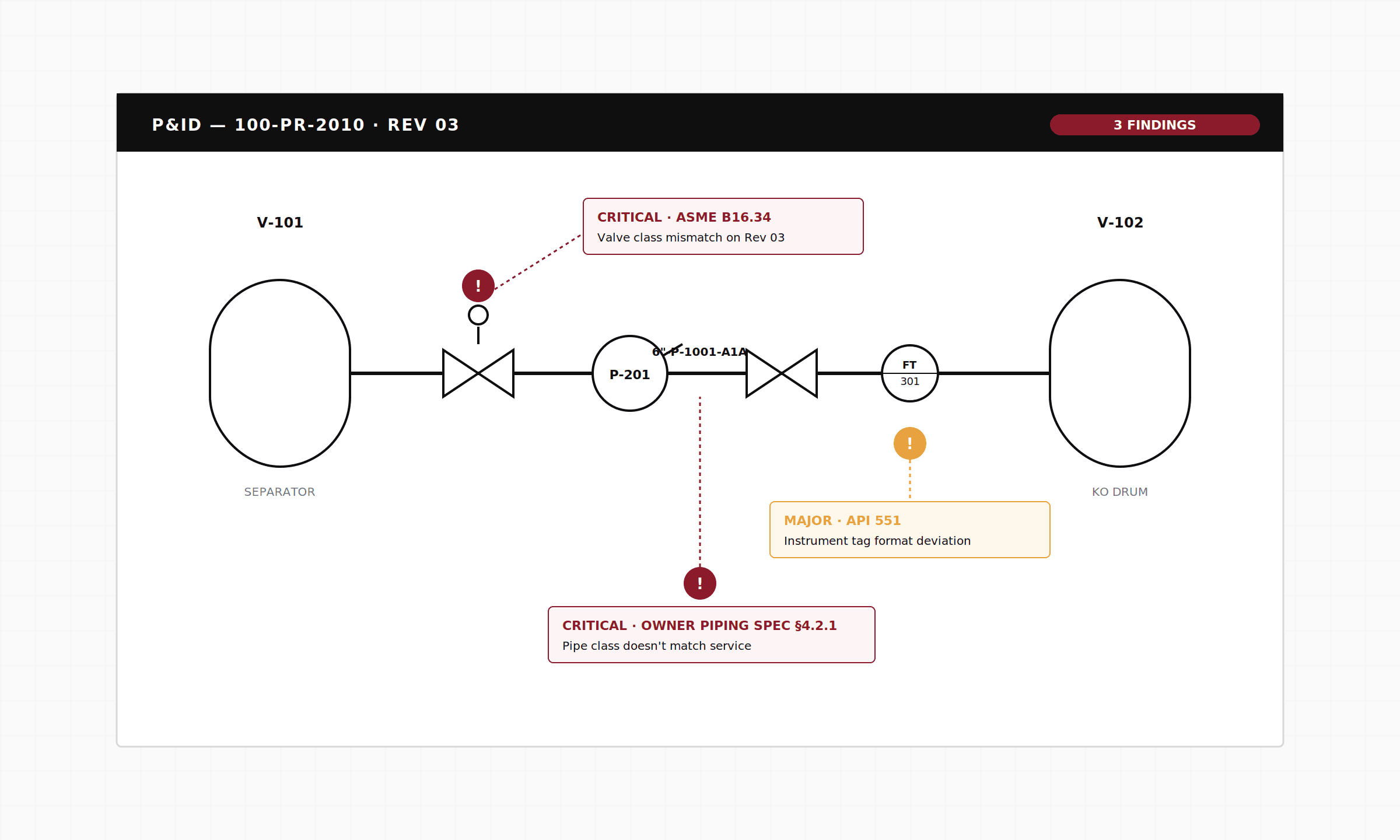
The drawing problem nobody quantifies
Every engineering organization knows drawing review is expensive. Few know exactly how expensive.
The compliance numbers most leaders quote are document-level numbers. Pages reviewed. Specs cleared. Standards covered. Drawings hide inside those numbers, even though they're the most labor-intensive thing on the desk.
A drawing is not a document. It's a hybrid object. Symbols, callouts, dimensions, tag references, and embedded annotations all carry compliance weight. Each one has to be checked against a layered stack of owner standards, international codes, and project addenda. Then the whole thing gets revised, and the review starts again.
That's the hidden cost. Not the first review. The second, third, and fifth.
What a single drawing review actually costs
The cost lives in five places, and each one tells the same story from a different angle. Here is what manual drawing review looks like today, and what teams running intelligent drawing verification are starting to see.
The interesting number isn't any single row. It's the gap. When standards coverage jumps from three to all applicable, the miss rate stops being a reviewer-discipline problem and becomes a structural one. When turnaround drops from weeks to a day, every downstream workflow compresses with it.
Now multiply that across a capital project. A single EPC package can carry hundreds of P&IDs, isometrics, and equipment datasheets. Every one of them follows the same curve. Senior reviewers run out before the package does. This is where compliance review automation stops being a productivity question and becomes a capacity question.
Why drawings break the systems we built to review them
Drawing compliance is hard for a reason. A single P&ID is not a paragraph. It's a stack.
Look at one drawing on a reviewer's desk, and you'll find a half-dozen separate compliance regimes sitting on the same sheet. Each one has its own standard. Each one needs to be checked against the right version. And the owner's project addenda can override any of them at any time.
What a single P&ID demands of one reviewer
Every layer above carries its own standard. A reviewer holds them all in working memory.
The standards stack is the second layer of the problem. Owner specs override base codes. Project addenda override owner specs. Get the precedence wrong, and a clean finding can be wrong for the right reasons. This is the layer where keyword-based tools fail completely.
And then there's fragmentation across the toolchain. The drawing lives in CAD. The standards live in a corporate library. The addenda live in email. The redlines live in a markup file. The non-conformance log lives in Excel. The reviewer is what holds them together.
CAD systems hold the drawings. They don't review them.
No CAD tool was built to evaluate a drawing against thirty applicable standards. No document management system was built to reason about engineering content. The work falls back on the reviewer, every single time.
Revision loops: the cost multiplier nobody talks about
Most cost analyses of drawing review stop at the first cycle. That's where the real number is hidden.
A typical engineering drawing goes through three to seven revisions before it's issued for construction. Each revision is a fresh review. And without revision intelligence, reviewers have to identify everything from scratch: what's new, what was already accepted, what was previously flagged but never resolved.
This is where the math gets ugly.
The same finding gets logged twice. A resolved issue silently regresses in the next revision and nobody notices. A reviewer who left the project takes the context with them.
NEW
Findings introduced in the current revision. The work to evaluate them lands fresh on the reviewer's desk.
RECURRING
Findings present in the previous revision and still present in this one. Should have been resolved. Quietly weren't.
RESOLVED
Findings that have been closed out properly between revisions. The category compliance leaders most want, and most rarely get clean data on.
REGRESSED
Findings that were resolved in a prior revision but reappeared in this one. The most expensive category, because nobody is looking for them.
Modern drawing verification platforms surface this delta automatically. Manual review almost never does. The cumulative cost of reviewing a single drawing over its lifecycle ends up three to five times the cost of the first review alone.
Auditability and the downstream cost of getting it wrong
The expensive misses aren't the ones caught in review. They're the ones caught later.
A piping class designation slips through a P&ID review at the design stage. Procurement orders the wrong spec. Fabrication welds the wrong pipe. The error is caught at site. Now the cost isn't a few hours of reviewer time. It's tens of thousands of dollars in material, schedule, and rework. Sometimes orders of magnitude more.
The further downstream a finding propagates, the more it costs to fix. Design errors are cheap. Procurement errors are expensive. Fabrication errors are catastrophic. And the further it travels, the harder it becomes to trace why nobody caught it.
This is where audit traceability matters operationally, not just defensively.
A defensible compliance audit trail for drawings needs three things. Every finding linked to a specific clause and source quote. Every drawing revision timestamped and preserved. Every reviewer action, including approvals, overrides, and rationales, logged automatically.
In manual workflows, this trail lives in spreadsheets the reviewer maintains alongside the work. It's only as strong as the reviewer's discipline at the end of a long week. Compliance verification software that ties findings to source clauses at the moment of review changes that. The trail becomes a byproduct of the work, not an artifact assembled after it.
What intelligent drawing verification looks like
The shift isn't human-out, machine-in. It's a different division of labor.
A modern platform reads the drawing and the standards together. It extracts symbols, callouts, dimensions, line specs, and instrument tags as structured engineering content. Then it reasons against every applicable code, with project addenda applied in the right precedence. Findings come back with severity, confidence, and citations attached.
The senior engineer doesn't leave the loop. The loop changes.
Reads drawings, not just text
Vision-language extraction understands what's on the sheet, including the symbols, the callouts, the cross-references. It's reading engineering content, not just the characters printed on it. This is the unlock that earlier-generation tools couldn't deliver.
Reasons across the full standards stack
Owner specs, international codes, and project addenda are applied in the correct precedence. When an addendum overrides a base code, the override is applied automatically. The reviewer doesn't reconcile the stack. The system does.
Tracks every revision, every finding
Every change is classified across revisions as new, recurring, resolved, or regressed. The audit trail is a byproduct of the work, not a spreadsheet maintained on the side.
What this changes operationally is direct. Senior engineers stop spending their hours on clause lookup. They spend them on judgment, which is the work that actually needs them. Drawing review automation is what makes the trade possible.
The early signals from active engagements line up consistently:
Directional outcomes from active engineering compliance engagements.
Design compliance review has been one of the most expensive workflows in engineering for a long time. It won't be for much longer.
FAQs