
Why this article exists
Enterprises rarely adopt AI compliance software because they read about it in a market report. They adopt it because the friction in their existing process becomes impossible to ignore.
Organizations often don't notice manual compliance review becoming a bottleneck until review cycles begin expanding quarter after quarter. The moment looks different at every organization, but it tends to follow the same pattern. A review cycle that used to take a week now takes three. A finding that should have been resolved keeps showing up. An audit announcement triggers a fire drill. A reviewer goes on leave and three projects stall.
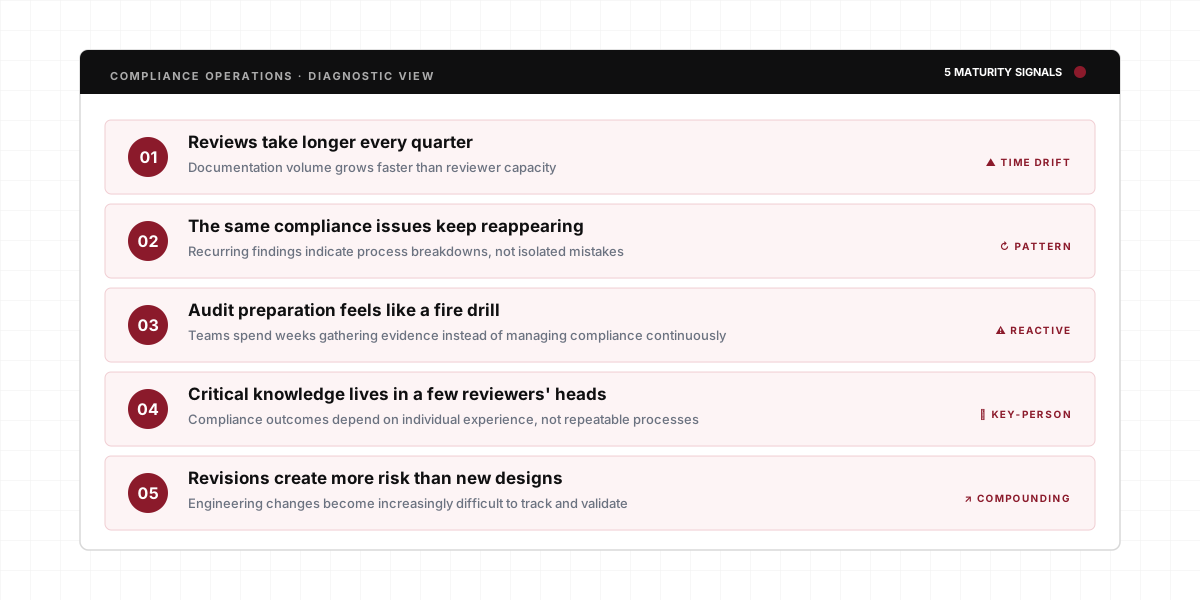
None of these are catastrophic on their own. Together, they are signs that the operating model has outgrown the manual approach that once worked. Compliance process automation enters the conversation when the pattern has been visible for long enough that nobody can dismiss it as a temporary issue. What follows are the five signs that pattern has arrived. If you recognize one, it is probably an isolated gap. If you recognize three or more, the friction is no longer something to manage. It is something to redesign around.
01
Reviews take longer every quarter
Documentation volume grows faster than reviewer capacity.
What it looks like
The package that used to clear in 10 days now takes 14. Next quarter, 18. Nobody can point to a single cause because there isn't one. Reviewers are working the same hours. Standards haven't changed dramatically. The queue just keeps lengthening, and the project plan now forms around it instead of being supported by it.
This is the most common sign and the easiest to dismiss. Schedule slips get attributed to scope creep, vendor delays, or reviewer turnover. Each individual quarter has a story. The pattern across quarters is what matters.
Review-cycle inflation is a capacity problem disguised as a productivity problem. Documentation volume in capital projects grows roughly 15 to 20 percent per year across the industries that drive compliance work. Senior reviewer capacity does not. The gap compounds quietly until compliance bottlenecks define every other project workstream, and compliance delays start showing up on the critical path of projects they used to support.
The creep is the diagnosis. No single quarter feels broken. The trend line tells the real story.
02
The same compliance issues keep reappearing
Recurring findings indicate process breakdowns, not isolated mistakes.
What it looks like
The finding raised on Project A in March is raised again on Project B in July. Different reviewer, different standard reference, same root issue. By Q4 you can predict the top five recurring findings before the review even starts. They aren't mistakes anymore. They are habits the system has not corrected for.
When the same finding keeps appearing, the problem isn't the reviewer. The system has no memory. Each review starts from scratch. Lessons from the last project don't carry forward. Patterns that should trigger preventive action stay locked in spreadsheets and inboxes.
This is one of the clearest signals that compliance has become reactive. A mature compliance operation surfaces recurring findings as a category and treats them as a process question, not a reviewer question. Most enterprises don't have the infrastructure to do this, which is why the same compliance inefficiencies keep coming back, project after project.
When the pattern is invisible to the system, every reviewer rediscovers it independently.
03
Audit preparation feels like a fire drill
Teams spend weeks gathering evidence instead of managing compliance continuously.
What it looks like
The PMC schedules a review. The next two weeks become a scramble. Engineers chase weld maps from email threads. MTRs surface from a folder nobody has opened in eighteen months. Hydrotest records turn up with missing signatures. The work was done correctly. The evidence was just never assembled in a way that survives an audit.
Audit pressure is the moment compliance debt becomes visible. The technical work happened. The reviewers signed off. The findings were resolved. But the audit readiness problems show up because the evidence trail was maintained on the side, not as a byproduct of the work itself.
Teams that live in fire-drill mode are not bad at compliance. They are running a model where the compliance documentation burden gets back-loaded. The audit is the moment the bill comes due, and the cost is always paid in senior-engineer hours that would otherwise be doing engineering.
PMC announces review.
Compliance documentation request issued. First scramble begins.
Evidence chase.
Engineers pull weld maps from email, MTRs from shared drives, hydrotest records from QA folders. Gaps surface.
Re-issue requests.
Missing signatures, expired calibrations, unassigned welds get flagged. Re-issue and re-sign requests go out.
Review begins.
Reviewer presents the dossier. Gaps explain themselves. Findings raised.
Closeout.
Findings worked off over the next two weeks. Same pattern repeats next quarter on the next audit.
04
Critical knowledge lives in a few reviewers' heads
Compliance outcomes depend on individual experience, not repeatable processes.
What it looks like
One reviewer goes on leave and three projects stall. A senior engineer retires and the team loses years of judgment that was never written down. The standards are documented. The owner specs are documented. The reasoning that connects them is locked inside a few people who have done this work for fifteen years.
This is the sign that scares Compliance Leads the most, because it is the hardest to fix with hiring. New reviewers can be trained on standards. They cannot be trained on the judgment that comes from a decade of reading the same owner specs against the same project addenda. That judgment is the integration layer of the compliance operation, and it cannot be replaced one reviewer at a time.
The compliance management challenges in this scenario are not technical. They are organizational. When the senior reviewer is out, the work stops. The operating model has quietly assumed that specific people will always be available, and the assumption breaks every time it gets tested.
Compliance has become a person, not a process.
05
Revisions create more risk than new designs
Engineering changes, updated standards, and document revisions become increasingly difficult to track and validate.
What it looks like
A Rev 03 should be easier than a Rev 01 because most of the work is already cleared. Instead, it's harder. Reviewers re-read everything to find what changed. Findings that were resolved in Rev 02 quietly regress and nobody notices. By Rev 05, no one is fully sure what was approved when, or against which version of the standard.
Revisions are where compliance debt compounds. The original design got the most attention. Each revision gets less. Yet revisions are also where late changes are introduced, where standards updates land, and where small errors propagate forward into the next version. The work that should require the least scrutiny ends up carrying the most risk.
This is the sign most often missed in maturity assessments because revisions don't fail loudly. They drift. The audit finds the drift months or years later, and by then the trail of what changed and why is genuinely difficult to reconstruct.
NEW
First appearance in this revision.
RECURRING
Present in prior rev, still unresolved.
RESOLVED
Closed between revisions, verified.
REGRESSED
Was resolved, now back. The most expensive category, because nobody is looking for them.
Manual review almost never produces this view. Without it, revisions accumulate risk invisibly.
Where you stand
Five signs. The question isn't whether you experience any of them. Every compliance operation has bad days. The question is how many of them describe your operation on a normal day.
Probably an isolated process gap.
Worth fixing internally. Tighten the specific workflow where the sign is showing up and watch whether the others appear over the next two quarters.
Structural friction.
The signs are no longer independent. Worth a serious look at whether the manual model is reaching its capacity. Compliance automation enters the conversation here.
The operating model has outgrown manual compliance review.
Headcount will not close the gap. The work itself needs to be redesigned, and an evaluation of intelligent compliance review is overdue.
This is where AI for compliance becomes a real consideration, and not a moment earlier. Enterprises evaluating compliance automation platforms today are not chasing a trend. They are responding to a pattern of friction that headcount and process tweaks have stopped fixing. AI compliance management as a category exists because the manual model has visibly stopped scaling for many enterprises, not because the technology is novel.
What changes when AI enters the workflow, based on early observations from active engagements: review cycles tend to compress meaningfully. Recurring findings start surfacing as patterns rather than being rediscovered each quarter. Audit trails can become byproducts of the work rather than artifacts assembled at the last minute. The senior reviewer stops doing AI document review work in their head and starts focusing on the judgment calls that actually need them. Revisions get tracked across versions, with findings classified by whether they are new, recurring, resolved, or regressed. An AI compliance agent embedded in this workflow takes on the lookup, the cross-referencing, and the citation work, so the reviewer can do the work that needs a human.
None of this replaces the senior engineer. It changes what the senior engineer's hours are for. That is the shift many compliance leaders are evaluating right now, and the signs above are how they know it is time.
FAQs